Chicken Coop and Chickens for Sale: Buyer's Checklist
A buyer's checklist for a chicken coop and chickens sold together, covering space, biosecurity, and NPIP questions, with official university extension sources.
Buy the house and the flock as one decision
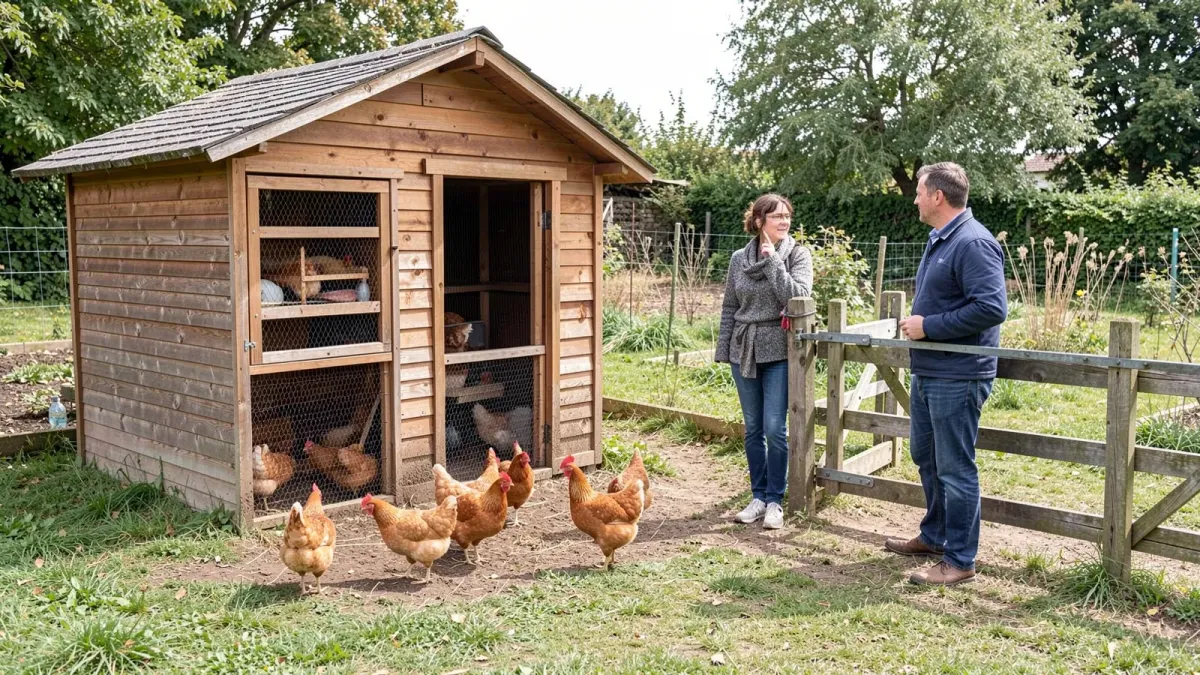
A listing that offers a chicken coop and chickens for sale can look like a shortcut: house, run, and birds in one weekend. Sometimes it is a sensible package. Sometimes it is a cute coop that is already too small, plus birds you cannot place in a quarantine pen because the only housing came with them. This is a buyer’s checklist for that package, not a price guide and not a veterinary diagnosis.
Start with capacity, not with color. Use the same extension figures you would use if you were buying the parts separately. Delaware Extension recommends at least 2 to 3 square feet per chicken inside the coop and 8 to 10 square feet in the run, with one nest per 3 to 4 hens, in its chicken housing fact sheet. Maryland Extension’s housing requirements give 1.5 square feet inside and 8 in the run for laying hens, and more for large fowl. If the seller’s “fits six hens” coop cannot meet those numbers for six hens, it does not fit six hens.
The attached run, latches, and ventilation matter as much as the birds. Our pen and coop checklist is the housing half of this purchase. For a wider look at layouts, see chicken coop ideas.
Look at the birds with a biosecurity mind, not only a camera
Healthy-looking birds in a clean photo are not a health certificate. The U.S. Department of Agriculture’s Animal and Plant Health Inspection Service describes the National Poultry Improvement Plan as a voluntary program through which participating flocks are monitored for certain diseases of concern, on its NPIP reference page. The program’s public site is poultryimprovement.org. NPIP participation is not a promise that a bird is free of every illness, and it is not a promise about breed quality or laying. It is still a useful question: is this flock in the program, and can the seller show current paperwork?
Ask where the birds came from, how recently they arrived, and whether new stock is kept apart from the established flock. Official biosecurity guidance for poultry keeps coming back to a simple idea: limit contact, control what comes onto the place, and do not mix untested birds straight into a group you care about. If the only housing in the deal is the one the seller’s birds already occupy, plan a separate quarantine pen of your own before the pickup, or walk away. This article will not invent a quarantine length or a medicine list. If a bird looks ill, stop and speak to a veterinarian; do not take shopping advice from a symptom.
Age, sex, and breed should be on the invoice in words you understand. A “starter flock” that includes a cockerel you cannot legally keep, or birds younger than the seller implied, is not a bargain. If you specifically want Silkies, use the questions in our silkie chicken breeders guide rather than accepting an unlabeled mixed box.
Inspect the coop as if you had to clean it tonight
Stand in the run if you can. If you cannot stand, you will be cleaning on your knees for as long as you own the thing. Look at the floor of the house, the lip of the pop door, and the first two feet of the run after you imagine a week of rain. Delaware and Maryland both stress drainage, dryness, and ventilation without a draft on the roost. A damp smell in a show coop is information.
Press on mesh and doors. Hardware cloth, solid latches, and a roof that sheds water away from bedding are more important than a cupola. Ask what the mesh actually is, including the opening size, and whether the run is enclosed overhead. A package deal sometimes skimps on the run because the birds in the photo are posed in the yard.
Measure interior length and width yourself. Do not accept a capacity line on a website as a substitute. Then divide by the number of birds in the deal, and by the number you might add next spring. If the seller will not let you measure, that is also information.
A buyer’s table for a coop-and-flock package
| Check | A passing answer | A reason to keep shopping |
|---|---|---|
| Space | Interior and run measurements meet extension figures for this many birds of this size | A stated capacity with no measurements, or a run that is mostly a photo backdrop |
| Housing quality | Dry floor, vents, hardware cloth, lockable latches, nests you can reach | Ornamental wire, a puddle at the pop door, or a house you cannot clean |
| Bird paperwork | NPIP participation you can verify, or an honest account of source and testing the seller does have | “They’ve always been fine,” with no paperwork and no isolation story |
| Flock match | Sex, age, and breed stated clearly, and legal to keep at your address | A surprise rooster, or birds that do not match the listing |
| Biosecurity plan | You have somewhere else to keep new birds at first, and a way to move them without mixing equipment | The package coop is the only housing, and it already holds the seller’s mixed-age flock |
| After-sale support | You know who to call if a door latch fails, and what is included | A cash handoff in a parking lot with no way to ask a later question |
If two packages both pass, choose the one you can clean and verify, not the one with the painted hearts on the roof.
A short checklist to take to the pickup
- Measure the coop and run, then compare with Delaware or Maryland space figures for your bird size.
- Inspect mesh, latches, roof overhang, vents, nests, and how you will get in to clean.
- Ask about NPIP or other official health paperwork, and write down what you were shown.
- Get age, sex, and breed in writing, and confirm local rules on roosters and flock size.
- Bring or pre-build a separate place to keep new birds at first, with their own water and feeders.
- Do not accept a sick-looking bird as part of a “package discount.” Stop and get veterinary advice.
- Photograph the housing and the paperwork at handover, and keep a copy of any receipt.
A cheap package that fails the space or biosecurity rows will cost you the next coop anyway.
Questions buyers ask about a coop and chickens sold together
Is a package deal safer than buying the coop and the birds separately?
Not automatically. It is safer only if the housing meets extension space and security tests, and if the birds come with a source history you can live with, including NPIP paperwork when it exists. Buying separately can actually make quarantine easier, because the new house can be empty when the birds arrive.
What does NPIP actually tell me?
It tells you that a participating flock is in a USDA-coordinated program that monitors for certain diseases. It does not tell you that a bird will never get sick, and it does not rate the seller as a person. Ask for a participant number or current documents, and if you are unsure, use the official NPIP or state agriculture resources to understand what you were handed.
The seller says the coop “fits eight chickens.” Should I trust that?
Only after you measure. Divide the interior floor and the run area by eight, then compare the result with official figures for the size of those birds. Marketing capacity is not an extension fact sheet.
Can I put the new birds straight in with a flock I already have?
That is a biosecurity risk this article will not bless. Official poultry biosecurity advice is built around not mixing untested birds and equipment. Plan a separate pen first. For medical questions about a specific bird, call a veterinarian, not the comments under the listing.