Chicken Coop Ideas: Practical Options Compared
Practical chicken coop ideas compared by space, predators, and daily work, using university extension figures rather than guesswork or borrowed plans.
Compare the housing system, not a pretty photograph
A chicken coop idea is only useful if you can count the birds, the square feet, the weather, and the predators you actually have. A listing titled “largest chicken coop” does not help if the run is an afterthought. A clever DIY coop does not help if you cannot clean it in the rain. This is a comparison of practical options, not a set of shop drawings and not a veterinary guide.
University extension services are the right place for starting figures. The University of Delaware Cooperative Extension recommends at least 2 to 3 square feet per chicken inside the coop and an additional 8 to 10 square feet per chicken in the outdoor run, plus ventilation without drafts, predator-proof latches and mesh, and nesting boxes at one box per 3 to 4 hens, in its chicken housing fact sheet. The University of Maryland Extension publishes a more detailed space table, including bantams at 1 square foot inside and 4 in an outside run, laying hens at 1.5 and 8, and large chickens at 2 and 10, in Housing Requirements. Penn State Extension, in Small Scale Poultry Housing, likewise uses at least 1.5 square feet indoors and 8 square feet outdoors per laying hen with outdoor access.
If an idea cannot meet those ranges for the flock you want, it is a decoration, not a plan. For the way the house and the pen have to work as a pair, see our chicken pen and coop checklist.
Fixed backyard coops, walk-in houses, and converted sheds
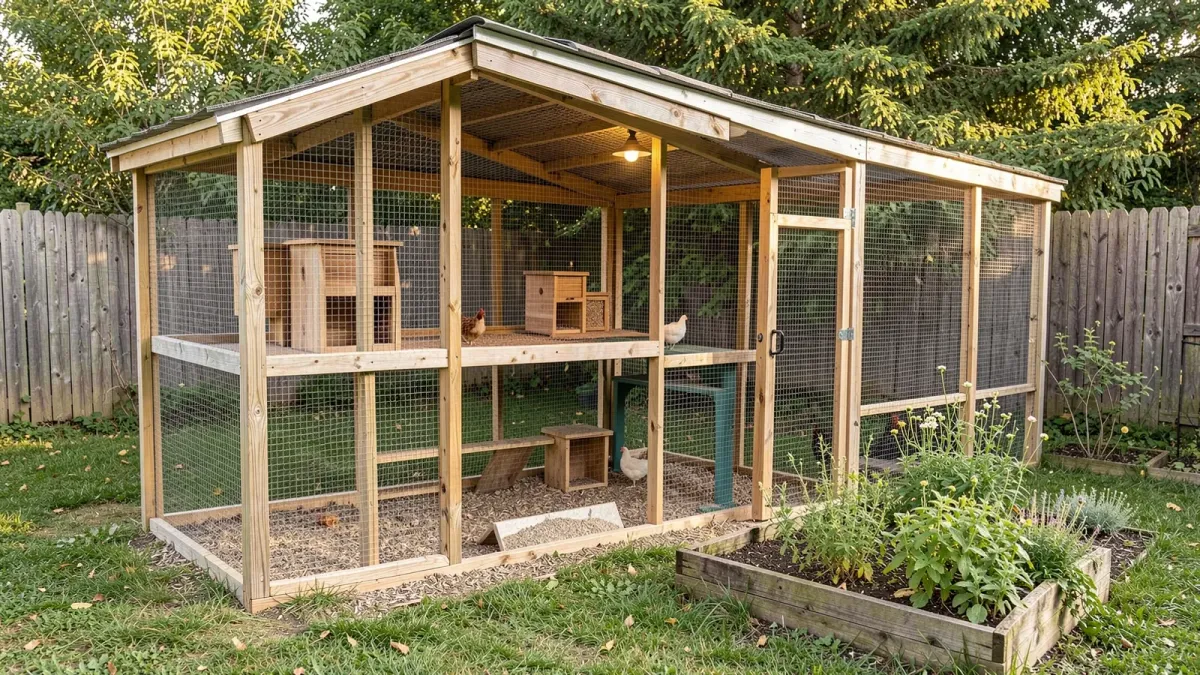
The most common backyard idea is a fixed coop with an attached run. It suits a small to moderate flock that will live in one place for years. The advantages are ordinary and valuable: a dry nest, a door you can lock, a roof that sheds water away from bedding, and a run you can stand in to change water. The failures are ordinary too: a floor that sits in a puddle, a run made of poultry netting that a raccoon can open, and a house so short you clean it on your knees in January.
A walk-in coop, or a converted garden shed with a pop door to a run, solves the cleaning problem if the floor, ventilation, and predator-proofing are done properly. Maryland notes that housing should sit in a well-drained area, be tight and well ventilated, and be comfortable for the birds. A shed that was designed to store tools may need more vents, a safe roost, nest boxes you can collect from outside, and hardware cloth instead of decorative wire. “How do you build a chicken coop” starts here: drainage, space, vents, and latches, then the pretty trim.
Elevated coops with a run underneath can keep bedding drier and make the floor harder for some digging predators to enter. They also concentrate droppings in a smaller patch and can be drafty if the floor is an open grate in a cold wind. If you use this idea, keep the run enclosed on all sides, including a buried or apron skirt against digging, and do not treat the shady undercroft as optional space that somehow replaces the extension figures above.
Mobile coops, tractors, and coops with a serious run
A transportable or tractor-style coop is a different idea, not a smaller version of a shed. It can give birds fresh ground and spare a permanent yard from becoming a dust bowl, but only if it still offers dry shelter, shade, and secure nights, and only if you will actually move it. We go through the buying points separately in the transportable chicken coop checklist. If your week already has no spare quarter-hour, a fixed house with a generous run is the more honest idea.
A coop with a large, covered run is often the better “largest” option than a huge house with a tiny yard. Delaware’s 8 to 10 square feet per bird in the run, and Maryland’s 8 to 10 depending on bird size, are easier to meet outdoors than by inflating a tiny house. Cover at least part of the run so rain does not turn the pop-door threshold into mud. If birds will forage beyond the run, you still need a lockable house at night.
Deep-litter fixed houses, hoop-style shelters, and open-air roosts in mild climates appear in many photo essays. They only count as ideas if you can keep bedding dry, keep drafts off roosting birds, and keep raccoons, dogs, and hawks out. A hoop house without a secure night enclosure is a summer camp, not a coop.
A comparison table for common coop ideas
Use this table to throw ideas out, not to decorate a Pinterest board. Local ordinances, homeowner rules, and neighbor lines come first, including bird limits and whether a rooster is allowed.
| Idea | Works well when | Poor fit when | A check before you commit |
|---|---|---|---|
| Fixed coop plus attached run | You have a drained site and will keep the same flock in one spot | The run cannot meet 8 to 10 square feet per bird, or the house sits in a puddle | Walk the site after rain. Measure interior floor and run, then divide by the number of birds. |
| Walk-in coop or converted shed | You want to clean standing up and can add vents, nests, and hardware cloth | The shed stays windowless and stuffy, or the door cannot be locked from a predator | Confirm ventilation without a direct draft on the roost, and a pop door you can close from outside. |
| Elevated coop with run under | Soil stays wet, or you need to keep bedding off saturated ground | Winter wind blows up through an open floor, or the undercroft is not fully enclosed | Enclose all sides; keep the official interior space, not just the footprint of the legs. |
| Tractor or mobile coop | You will move it on a schedule and can keep birds safe while it sits | The unit is too heavy to move, or nights are left to flimsy mesh | Read the mobile checklist, and still count shelter and run space for the actual breed size. |
| “Largest” commercial kit | The stated capacity still matches extension space for your breed | Capacity is a marketing number with no interior measurements | Ask for interior length, width, and height, and for the run’s true area, then do the arithmetic yourself. |
DIY plans belong in the same table. “How to make a chicken coop” is not a different category of physics. The same space, mesh, and ventilation tests apply, whether the lumber comes from a kit or from the shed.
A short checklist before you fall for a coop idea
- Count the birds you will have in six months, not only the three pullets in the car this Saturday.
- Measure proposed interior and run space, then compare with Delaware, Maryland, or Penn State figures for the size of bird you keep.
- Look at drainage, shade, and how you will close the pop door at dusk without a chase.
- Choose hardware cloth and solid latches over ornamental wire. Predators test ideas at night.
- Plan nests (one per 3 to 4 hens, in Delaware’s guidance), roosts, and a way to collect eggs without crawling through bedding.
- Be honest about whether you will move a mobile coop. If you will not, pick a fixed idea with a better run.
- Check local rules before you pour a pad or order a kit.
If you are also buying birds with the housing, use the coop and chickens for sale checklist so the capacity of the house and the size of the flock are decided together.
Questions people ask when they compare chicken coop ideas
What is the best chicken coop idea for a first flock?
The best first idea is a dry, lockable house with a run that meets extension space figures for your birds, and a layout you can clean. That is usually a fixed coop and run, or a walk-in shed conversion, not the most elaborate tractor. Style is a later decision.
Can I use a DIY plan I found online?
You can, if you still do the arithmetic and the predator check. A plan that never states interior floor area, mesh type, or ventilation is not finished. Compare it with the Delaware and Maryland figures, and adjust up for large breeds.
How big should a “coop with run” be?
Start from the official ranges: roughly 1.5 to 3 square feet per bird inside, depending on the source and the size of the bird, and 8 to 10 square feet in the run for typical laying hens, more if you can give it. Do not use the smallest number in a table as a target for a clearly large breed.
Is a mobile coop always more “natural,” and therefore better?
It can be a good idea when you will move it and when shelter still stays dry and secure. It is not automatically better, and it does not waive space or predator rules. If the yard cannot be rotated, a fixed house with a well-built run is the more practical option.