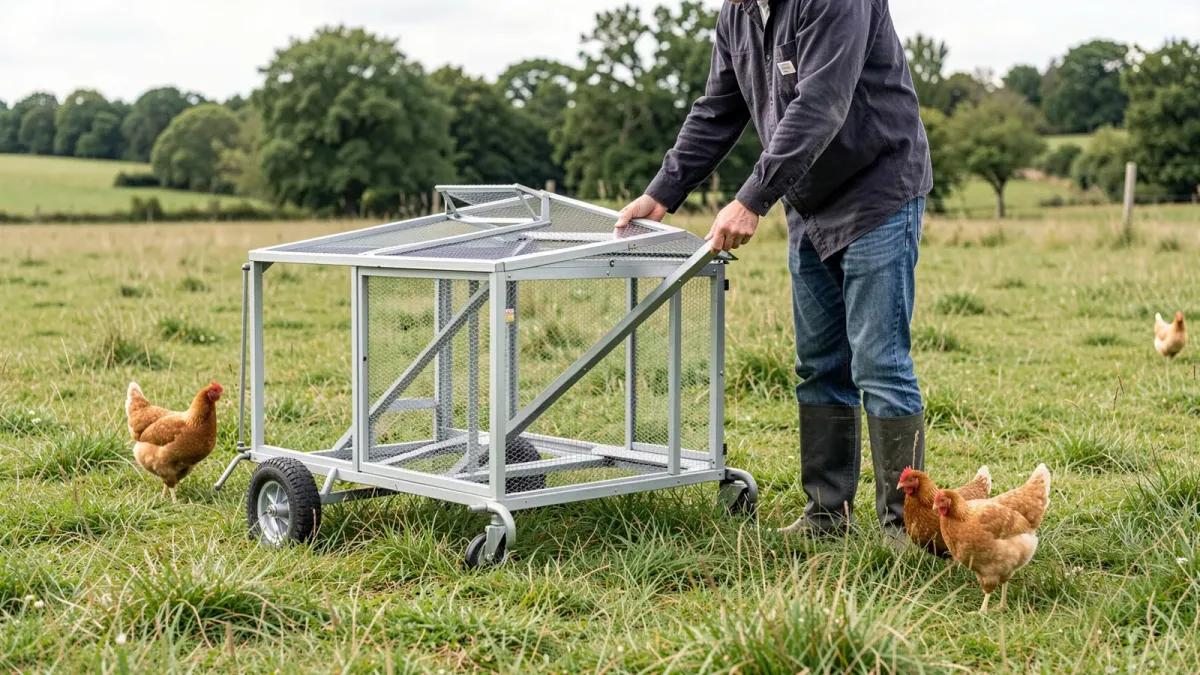
Transportable Chicken Coop: Buyer's Checklist
A buyer's checklist for a transportable chicken coop, covering space, movers, predators, and pasture, drawn from official university extension housing guides.
A movable coop still has to be a real coop
A transportable chicken coop, sometimes sold as a tractor or a mobile hen house, is a bargain only if you will move it, and only if it still gives the birds a dry, lockable shelter. Wheels do not replace square feet, and a bright coat of paint does not replace mesh. This is a buyer’s checklist, not a set of build plans and not a veterinary guide.
Space still comes first. Penn State Extension’s Small Scale Poultry Housing uses at least 1.5 square feet indoors and 8 square feet outdoors per laying hen with outdoor access. Delaware Extension recommends 2 to 3 square feet inside and 8 to 10 in the run, in its chicken housing fact sheet. Maryland’s table, in Housing Requirements, scales by bird size. A mobile unit that only meets those numbers “if you move it twice a day and count the whole orchard” is not meeting them at 3 p.m., when the coop is sitting still.
If you are still choosing among layouts, start with chicken coop ideas and the fixed-housing points in our chicken pen and coop checklist. A transportable design is one option in that comparison, not a loophole.
Movers, weight, and the floor you will actually pull
The first practical test is whether one or two people can move the unit on your ground, in your weather, after you add birds, feeders, and wet bedding. Ask for the empty weight, the dimensions, and how the axles or skids are built. Then be honest: a “mobile” coop that takes a tractor and a dry week is a movable building, not a daily tractor.
Look at the floor. An open floor can give birds access to fresh ground and can also give predators a digging line, or let the unit bog in mud. A solid floor stays cleaner in a wet season and needs a planned run or a tractor skirt so birds can still forage when you park. There is no single official floor type; there is only a floor that matches your predators, your soil, and your willingness to move the thing before the patch becomes a soup.
Penn State’s guide to raising pastured broilers discusses moving pasture shelters on a frequent schedule so manure does not pile up and grass can recover. That guide is written for meat birds in tractors, not as a universal law for backyard layers, but the principle travels: a mobile coop that never moves is just a small, often under-secured, fixed house. University of Minnesota Extension also describes practical mobile poultry housing in its Farmbytes mobile poultry hut material. Use those pages for ideas about structure and movement, then still apply layer space figures to a laying flock.
Check how you will close birds in before a move, and how you will water them after. A design that spills the waterer each time you pull it will not be moved as often as you promised yourself in April.
Predators, weather, and the night the wheels do not help
Mobility can tempt people to leave mesh light “because we will be in a new spot tomorrow.” Predators do not honor that plan. You still want hardware cloth, secure latches, and an enclosed night space. An overhead cover matters if hawks are a local problem, and a skirt or buried edge matters if something digs. The official housing pages above still ask for ventilation without a draft on the roost, and for a dry interior. A tractor with no waterproof roof is a summer crate.
Think about winter and storm weeks. If you cannot move the coop through snow or mud, you need a winter pad or a fallback run that still meets space and security tests. Wheels and hitches should be serviceable; a seized axle turns a transportable coop into a badly placed shed.
Electric netting or a day paddock around a parked tractor can add space, but it is only as good as the fence and the supervision. It does not replace a lockable house at night.
A buyer’s table for a transportable coop
| Check | A passing design | A design to leave in the catalog |
|---|---|---|
| Space at rest | Interior and available yard under or beside the unit meet extension figures for your flock when the coop is parked | Capacity claims that count a whole pasture the birds cannot actually reach |
| Moving it | You can move it on your ground, with your equipment, on the schedule you intend | It takes a dry field, a tractor you do not own, and two neighbours who are not home |
| Floor and mud | A floor and skirt that match your soil, with a plan for wet weeks | An open floor that will sink, or a solid floor with no way for birds to use fresh ground |
| Security | Hardware cloth, solid latches, a closeable night area, and no easy digging line | Decorative netting, an open night roost, or a door that will not stay shut on a slope |
| Daily use | Water, feed, and egg collection still work after a move | Everything tips, and the nest is reachable only if you crawl under the axle |
| Off-season plan | A winter or storm position that is still dry and secure | “We will just keep rolling it” through a month of ice |
If the table is a mixed bag, fix the unit on paper before you pay, or choose a well-built fixed coop and spend your movement energy on a better run.
A short checklist to take to the seller, or to the build
- Measure interior shelter and the parked outdoor area, then compare with Penn State, Delaware, or Maryland figures for your bird size.
- Test, or at least honestly estimate, the moving weight on your own ground, not on a paved lot.
- Inspect floor, roof, vents, mesh, latches, and how you close birds in before a pull.
- Plan water, feed, and egg collection after each move.
- Write down a moving schedule you will keep, and a fallback pad for weeks you cannot move.
- Check predators in your actual yard, including night visitors, before you accept light mesh.
- Confirm local rules; a mobile unit is still a chicken house in the eyes of an ordinance.
A transportable coop is a tool for people who will use the wheels. If you will not, buy the static option and do it well.
Questions buyers ask about a transportable chicken coop
How often do I have to move it?
Often enough that the ground does not become a manure pack and a mud hole. Pastured-poultry guides, including Penn State’s broiler tractor discussion, talk about frequent moves to protect pasture. Your own interval depends on bird number, grass, and weather. If you already know you will not move it weekly, this may not be your design.
Can a tractor replace a run?
Only if the parked unit still gives birds the outdoor space extension services describe, plus a dry, secure shelter. A thin rectangle of wire that is dragged onto bare dirt is not a run. Some keepers add a fenced paddock around a parked tractor; that paddock still needs to be secure.
Is a lighter coop always better?
It is easier to move, and it may be easier for a predator or a windstorm to shift. Judge the frame, the mesh, and the latches, not only the empty weight. A slightly heavier unit you can still move is better than a light one you do not trust at night.
Can I keep a transportable coop in a small suburban yard?
Sometimes, if ordinances allow, if you have a path to move it, and if parked space still meets official figures. A tiny backyard with no route around the garden beds is usually better served by a fixed coop and a well-built run. Wheels are not a way to hide a flock from a rule that already limits birds or buildings.